








D. R. Congo: The hardest part…Λ. Δ. Κονγκό: Το δυσκολότερο κομμάτι…
 July 23rd, 2014 |
  Author:
 Brazzaville and Kinshasa are the two capitals being closest to each other in the world! They are just 1.6 km (1 mile) far from each other, separated only by the Congo River. However, crossing borders using the barge that connects the two capitals is one of the most difficult endeavours worldwide, especially for white people traveling on their own wheels. So we decided to make a detour of 580 kilometers (360 miles), most of them ridden on dirt roads, in order to enter the notorious Democratic Republic of the Congo through a small and remote border post.
Even at that small border post though, the officers did not like the fact that we have had our visas issued in Benin instead of Greece. We explained to them that it was literally impossible for us to take the visas in our own country of residence, since we had left eleven months ago and any visa would have expired by now. They called the head of the office in order to take some guidelines but in the meanwhile it got dark, so we found ourselves pitching our tent just outside the police department! Christina made a yummy potato salad and, after having had dinner, we entered inside our tent.

Just another flat tyre…
Next morning, after having been given the green light by the head officer, we had our passports stamped and we officially entered the Democratic Republic of the Congo. At Luozi, the first town we encountered, we had to declare ourselves again to the immigration service (DGM). Same story again… At first they were asking us for 40 USD in order to give us back our passports, then the price dropped at half and, since we insisted that we did not have any money, finally after two hours they let us go. So, that was the country we had read so much about… During us crossing the country we were stopped in 20 checkpoints in total and almost everyone demanded some bribing.
That was when Christina was taking care of the situation… Christina was working as a civil engineer in Greece, meaning that almost everyday she would pay a visit to some urban planning office. After having had such a long experience dealing with corrupted and slimy public officers, you can imagine how great she was when handling with the African public officers… Finally we managed to cross the entire country without having to participate in this dirty game of bribing.

The capital’s luxurious downtown
In the end, it took us three days to travel the distance between the two closest capitals on the planet! When we arrived in Kinshasa, we tried to contact Christophe and Cynthia, the two Belgians that would host us there. However, we found out that we had a wrong telephone number. We pulled over in order to think over our alternatives and it was then when a series of unbelievable coincidences began… A French motorcyclist spotted us, who had participated in the Paris – Dakar Rally during his youth. When we told him that we intended to reach overland Lubumbashi, in the south of the country, he took us for mad and immediately called a friend of his, who was a motorcyclist too. He handed us over the phone and we found ourselves talking in Greek with George, who happened to be the owner of the house Christophe and Cynthia were staying at!

It was in Kinshasa where we received the Sena Bluetooth Audio Pack, which allows us to record in our videos all of our conversations through the intercommunication system!
George arrived on his Honda CRF 450 in no time while we were still trying to understand what was happening! For the next few days we were part of a wonderful company, filled with Christophe and Cynthia’s laughter. We needed some time in order to organize ourselves the best we could, as the part of our trip which was expected to be the most difficult was ahead of us…

The shiny smiles of Christophe and Cynthia were making our days in the gloomy capital brighter.
Kinshasa, the capital, is about 2,500 kilometres (1,553 miles) far from Lubumbashi, the country’s second largest city. Most people consider that the linking of these cities by land is non-existent so they move from one to another only by air. There is a network of rough dirt roads crossing through the jungle linking the two cities but very few foreign travellers have attempted to travel on them. They are even fewer those who have reached their destination with their vehicle still functioning…
Akis Temperidis and Vula Netu had loaded their Land Rover on an airplane in order to transport it from the one mega city to the other. That was the right choice, actually, since the route is almost impassable for a four-wheeler. As proof stands the story of a Land Cruiser, which was wrecked after 39 days on this route… It takes around three months for some Congolese truck drivers to drive from one city to another, if everything goes smooth with no serious breakdowns on their vehicle.

In some parts the scenery was breathtaking…
Luckily, this route is not so rough for a motorcycle. A few motorcyclists that have tried it, completed it in just a couple of weeks. Nevertheless, the route showed its teeth to Stergios and his two fellow travelers. From the first days the French guy on his BMW F800 GS gave up because of a worn out clutch. Next day, it was the turn of Stergios to give up with his Vespa for the same reason. Finally, it was only Steven who rode to his destination on his Yamaha XT 125, as this was obviously the lighter and most proper motorbike for this kind of route, without escaping a breakdown though.
After having done some maintenance on both our Honda XR 250s, checking all the screws for possibly loose ones because of the long off-road riding, we left behind us the capital and its crazy traffic jams. The first 622 kilometres (386 miles) were on tarred roads. From there, the hardest part of our trip was on…

We covered our air filters with body stockings, in order for them to keep most of the dirt, making it easier for us to clean it in the middle of the jungle! A brilliant idea of our mechanic, Dimitris Katigiannis from NRG.
Christina had to face once more the terrain that she despises the most: sand! In the Sahara she had done some extended training of hundreds of kilometres. However, riding was not so tough there because there were hardly any ruts, so we could just accelerate and keep moving quite smoothly. The road to Tshikapa, on the other hand, was full of ruts made by the trucks. They were so deep that even my panniers were crashing on the sides. During those days we would drop our motorbikes around five times each. As expected, Christina was having a hard time and in order to cross some parts, I had to take both our motorcycles. After all that was the deal we had made: I would deal with the dirt roads and Christina would deal with the cops 😉
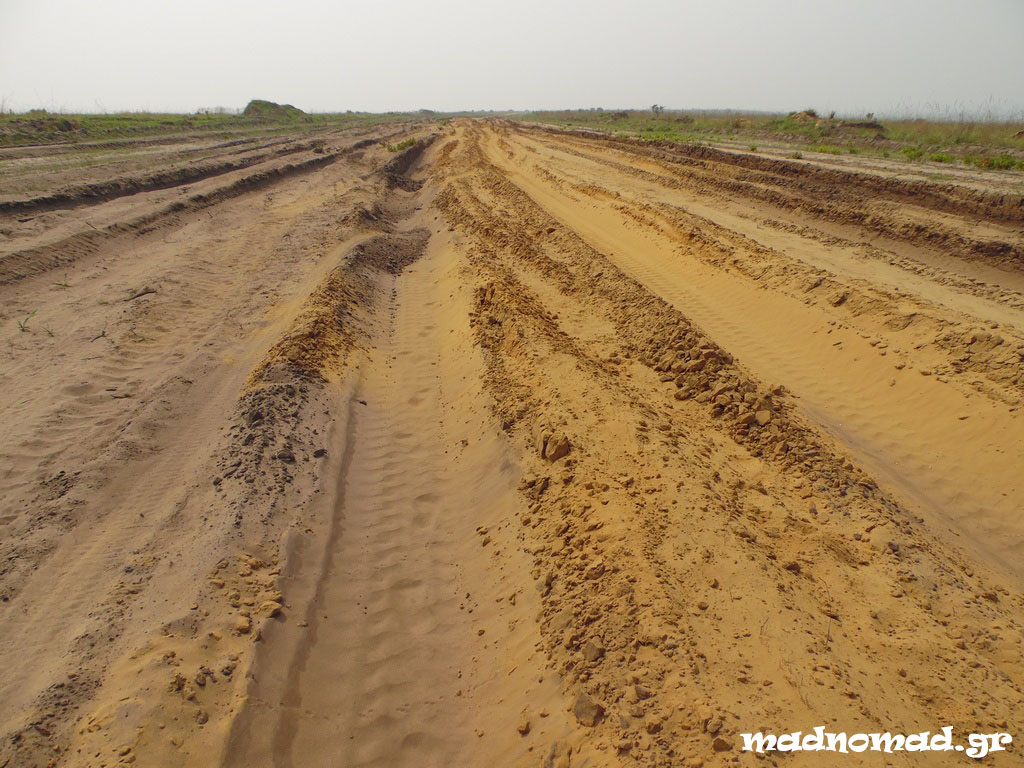
The terrain Christina hates the most: sand, with deep ruts on top of it…
Things were not much easier for me either, as I carry most of our luggage on my motorbike. It is not easy for anyone to balance 220 kg (485 pounds) on such a rough terrain… During those days we would not cover more than 70 kilometres (43 miles) before dusk. It was crucial for us to look for the trails that the locals use to move their overloaded bicycles. These bicycles are so heavily loaded that nobody rides them. Usually they are just being pushed by two or three individuals. That is how most of the goods are being transported to the villages and cities that are located in the jungle, and that’s why their cost is unbelievably high. You can find gas everywhere in jerry cans, sold from 1.7 to 3 euros per litre!

From the first day I noticed something unbelievable on my motorcycle: the front axle’s bracket was cracked! I had no choice but to place it on Christina’s motorbike, as she carries much less weight, praying for it to last…
On the third day on this route, while we were struggling in this hell, we met three local motorcyclists, who suggested us to travel altogether to Tshikapa. During the first five minutes Christina threw herself inside a deep rut and it crossed my mind that the others would be fed up with waiting us and would continue without us. Strangely enough though, after having pulled the motorcycle out of the ditch, Christina was leading the whole team, riding like a true enduro rider! I had never seen her riding like this on the trails and I could not believe my own eyes! We even rode in fourth gear, cornering our XRs on narrow trails. This was one of the parts of this route that I enjoyed riding very much…

The most beautiful place where we wild-camped on this route… We spent almost one hour inside the cool water of this river!
We had become a great team, co-operating immaculately. One of the locals was leading us, as he knew the right trails, Christina was following, so that she could get some help every time she dropped her motorbike, while I was riding at the end of the queue helping the locals whenever they would get stuck with their Chinese motorbikes. We were on a pretty good pace and we managed to cover 110 kilometers (68 miles) that day, arriving in Tshikapa, which was the first town we encountered.

Many parts of this route are almost impassable for a four-wheeler.
On some police roadblock, Christina played her magic tricks once more and we left without having to open our wallet. For our friends, however, it was not that easy… One of the cops untied the luggage from the back of one of the motorbikes and helped himself to a jacket he found, while the owner was looking at the scene helpless without being able to react and I was trying hard to take in what was going on… The Congolese have to deal with such brutal violence coming from the authorities of this country that unfortunately, they live in terror, without anybody reacting in anything. They all know that the police and military officers are authorized, armed mere criminals.

At the house of the cousin of one of the three local motorcyclists with whom we traveled together for a day!
When we arrived in Tshikapa, our friends led us straight to the house of their cousin, in order to spend the night there altogether. Their family was really glad to see them after such a long trip and the women immediately lit up the coals and started cooking. In these countries almost everyday the food staple is a dough-like ball, usually made from cassava or corn flour. They accompany this with relishes made from green leaves, and maybe some fish or meat, if they can afford such a treat. They brought us a bucket of water to take a shower and refresh ourselves after so much sweat and dust stuck on our bodies all those days. Then they laid a piece of foam mattress on the floor for us to sleep…
Η Μπραζαβίλ κι η Κινσάσα είναι οι δυο πιο κοντινές πρωτεύουσες στον κόσμο! Απέχουν μόλις 1,6 χιλιόμετρα και τις χωρίζει μόνο ο Ποταμός Κονγκό. Ωστόσο, η διάσχιση των συνόρων με τη σχεδία που πλέει από τη μια πρωτεύουσα στην άλλη είναι μια από τις πιο δύσκολες στον κόσμο, ειδικά για λευκούς που ταξιδεύουν με δικό τους όχημα. Έτσι αποφασίσαμε να κάνουμε έναν κύκλο 580 χιλιομέτρων, τα περισσότερα από τα οποία ήταν σε χωματόδρομους, με σκοπό να μπούμε στην προβληματική Λαϊκή Δημοκρατία του Κονγκό από έναν μικρό κι απομακρυσμένο συνοριακό σταθμό.
Ακόμη και σ’ εκείνον το μικρό σταθμό δεν άρεσε στους συνοριακούς υπαλλήλους το γεγονός πως είχαμε πάρει τις βίζες μας απ’ το Μπενίν κι όχι από την Ελλάδα. Τους εξηγήσαμε πως ήταν αδύνατον να πάρουμε τις βίζες απ’ τη χώρα μας, αφού είχαμε φύγει από ‘κει πριν έντεκα μήνες, οπότε οποιαδήποτε βίζα θα είχε λήξει. Καθώς αυτοί τηλεφωνούσαν στον ανώτερό τους για να τους πει τι να κάνουν, βράδιαζε κι έτσι κατασκηνώσαμε έξω απ’ το αστυνομικό τμήμα, κυριολεκτικά! Η Χριστίνα μαγείρεψε μια νόστιμη πατατοσαλάτα κι αφού φάγαμε, μπήκαμε στο αντίσκηνό μας.
Κι άλλο σκασμένο λάστιχο…
Το επόμενο πρωί, κι αφού ο διοικητής είχε δώσει την έγκρισή του, σφράγισαν τα διαβατήριά μας κι έτσι μπήκαμε κι επίσημα στη Λαϊκή Δημοκρατία του Κονγκό. Στο Luozi, την επόμενη κωμόπολη που συναντήσαμε, μας ανάγκασαν να δηλωθούμε πάλι στην υπηρεσία αλλοδαπών. Πάλι η ίδια ιστορία… Μας ζητούσαν 40 δολάρια για να μας δώσουν πίσω τα διαβατήριά μας, ύστερα η τιμή έπεσε στο μισό, κι αφού επιμέναμε πως δεν έχουμε χρήματα, μας άφησαν, τελικά, να φύγουμε μετά από δυο ώρες. Αυτή ήταν η χώρα για την οποία είχαμε διαβάσει τόσα… Μέχρι να τη διασχίσουμε μας σταμάτησαν σε 20 μπλόκα και σχεδόν όλοι απαιτούσαν να τους δωροδοκήσουμε.
Τότε ήταν που έμπαινε μπροστά η Χριστίνα… Η Χριστίνα εργαζόταν στην Ελλάδα ως πολιτικός μηχανικός κι αυτό σημαίνει πως σχεδόν κάθε μέρα βρισκόταν στην πολεοδομία. Μετά από τέτοια προϋπηρεσία στις συνδιαλλαγές με διεφθαρμένους και γλοιώδεις δημόσιους υπαλλήλους, καταλαβαίνετε πόσο περίφημα τα πήγαινε με τους Αφρικανούς δημόσιους υπαλλήλους… Τελικά καταφέραμε να διασχίσουμε ολόκληρη τη χώρα χωρίς να χρειαστεί να μπούμε σ’ αυτό το βρώμικο παιχνίδι των δωροδοκιών.
Το πολυτελές κέντρο της πρωτεύουσας
Τρεις μέρες μας πήρε τελικά για να ταξιδέψουμε ανάμεσα στις δυο κοντινότερες πρωτεύουσες του κόσμου! Φτάνοντας στην Κινσάσα, προσπαθούσαμε να τηλεφωνήσουμε στον Christophe και τη Cynthia, τους Βέλγους που θα μας φιλοξενούσαν εκεί. Διαπιστώσαμε, όμως, πως μας είχαν δώσει λάθος τηλεφωνικό αριθμό. Σταματήσαμε κάπου για να σκεφτούμε τι μπορούμε να κάνουμε και τότε άρχισε μια σειρά απίστευτων συμπτώσεων… Μας είδε κάποιος Γάλλος μοτοσυκλετιστής, ο οποίος στα νιάτα του έτρεχε στο Paris – Dakar. Όταν του είπαμε πως θέλουμε να φτάσουμε οδικώς μέχρι το Lubumbashi, στα νότια της χώρας, μας θεώρησε τρελούς και τηλεφώνησε αμέσως σ’ ένα φίλο του, επίσης μοτοσυκλετιστή. Μας έδωσε το τηλέφωνο και βρεθήκαμε να μιλάμε ελληνικά με τον Γιώργο, που τύχαινε να είναι ο ιδιοκτήτης του σπιτιού όπου έμεναν ο Christophe κι η Cynthia!
Στην Κινσάσα παραλάβαμε το Sena Bluetooth Audio Pack, που μας επιτρέπει να ηχογραφούμε στα βίντεό μας τις συνομιλίες που κάνουμε μέσω του συστήματος ενδοεπικοινωνίας!
Ο Γιώργος ήρθε αμέσως να μας πάρει με το Honda CRF 450 του κι εμείς προσπαθούσαμε να συνειδητοποιήσουμε τι συνέβαινε! Τις επόμενες μέρες βρεθήκαμε ανάμεσα σε μια υπέροχη παρέα, που γέμιζε απ’ τα γέλια του Christophe και της Cynthia. Εκεί έπρεπε να οργανωθούμε όσο καλύτερα μπορούσαμε, αφού είχαμε μπροστά μας το κομμάτι του ταξιδιού που αναμενόταν να είναι το δυσκολότερο…
Τα λαμπερά χαμόγελα του Christophe και της Cynthia φώτιζαν τις μέρες μας στη μουντή πρωτεύουσα.
Η Κινσάσα, η πρωτεύουσα της χώρας, απέχει περίπου 2.500 χιλιόμετρα από το Lubumbashi, τη συμπρωτεύουσα. Οι περισσότεροι θεωρούν πως αυτές οι δυο πόλεις δε συνδέονται οδικώς και μετακινούνται μόνο αεροπορικώς ανάμεσά τους. Υπάρχει ένα δίκτυο από δύσβατους χωματόδρομους που διασχίζουν τη ζούγκλα και συνδέουν τις δυο πόλεις, αλλά ελάχιστοι ξένοι ταξιδιώτες τους έχουν δοκιμάσει. Ακόμη λιγότεροι έχουν φτάσει στον προορισμό τους με το όχημά τους σε λειτουργία…
Ο Άκης Τεμπερίδης κι η Βούλα Νέτου είχαν βάλει το Land Rover τους σε αεροπλάνο για να το μεταφέρουν απ’ τη μια μεγαλούπολη στην άλλη και πολύ καλά έκαναν, αφού για ένα τετράτροχο η διαδρομή είναι σχεδόν απροσπέλαστη. Για του λόγου το αληθές, μπορείτε να δείτε πώς καταστράφηκε ένα Land Cruiser μετά από 39 μέρες σ’ αυτήν τη διαδρομή… Κάποιοι Κονγκολέζοι φορτηγατζήδες που οδηγούν ανάμεσα στις δυο πόλεις, χρειάζονται γύρω στους τρεις μήνες για να ολοκληρώσουν τη διαδρομή, αν δεν αντιμετωπίσουν σοβαρή βλάβη στ’ όχημά τους.
Σε κάποια σημεία το τοπίο ήταν μαγευτικό…
Ευτυχώς, η διαδρομή δεν είναι το ίδιο δύσβατη για μια μοτοσυκλέτα. Μερικοί μοτοσυκλετιστές που την έχουν δοκιμάσει, την ολοκλήρωσαν σε μόλις δυο ‘βδομάδες. Ωστόσο, η διαδρομή αυτή έδειξε τα δόντια της στο Στέργιο και τους δυο μοτοσυκλετιστές φίλους του. Από τις πρώτες κιόλας μέρες, εγκατέλειψε ο Γάλλος με τη BMW F800 GS λόγω καμένου συμπλέκτη. Την επόμενη μέρα εγκατέλειψε κι ο Στέργιος με τη Vespa του για τον ίδιο λόγο. Τελικά, καβαλάρης στον προορισμό του έφτασε, μετά από κάποιες βλάβες, μόνο ο Steven μ’ ένα Yamaha XT 125, που προφανώς ήταν το ελαφρύτερο και καταλληλότερο μηχανάκι γι’ αυτήν τη διαδρομή.
Αφού έκανα ένα service στα δυο μας Honda XR 250 κι έλεγξα όλες τις βίδες που πιθανόν να είχαν χαλαρώσει από την εκτεταμένη εκτός δρόμου οδήγηση, αφήσαμε πίσω μας τα παρανοϊκά μποτιλιαρίσματα της πρωτεύουσας. Τα πρώτα 622 χιλιόμετρα ήταν σε άσφαλτο. Από ‘κει και πέρα, όμως, ξεκινούσε το δυσκολότερο κομμάτι της διαδρομής…
Τα φίλτρα αέρος τα βάλαμε μέσα σε καλσόν, που κρατούσε το πολύ χώμα κι έτσι μπορούσαμε να τα καθαρίζουμε εύκολα στη μέση της ζούγκλας! Μια καταπληκτική ιδέα του μηχανικού μας: του Δημήτρη Κατηγιάννη απ’ το NRG.
Η Χριστίνα αντίκρισε ξανά το στοιχείο που μισεί περισσότερο: την άμμο! Στη Σαχάρα είχε κάνει μια αρκετά εκτεταμένη προπόνηση εκατοντάδων χιλιομέτρων, αλλά εκεί δεν ήταν τόσο δύσκολη η οδήγηση, αφού δεν υπήρχαν ροδιές, οπότε μπορούσαμε ν’ αυξήσουμε την ταχύτητά μας και να κινούμαστε άνετα. Ο δρόμος προς την Tshikapa, όμως, ήταν γεμάτος ροδιές από τα φορτηγά, οι οποίες ήταν τόσο βαθιές, που χτυπούσαν οι βαλίτσες μου στα τοιχώματα. Εκείνες τις μέρες πέφταμε γύρω στις πέντε φορές ο καθένας μας. Όπως ήταν αναμενόμενο, η Χριστίνα ζοριζόταν ιδιαίτερα και σε κάποια κομμάτια έπρεπε να παίρνω εγώ τη μοτοσυκλέτα της. Αυτή ήταν κι η συμφωνία άλλωστε: εγώ τους χωματόδρομους κι η Χριστίνα τους μπάτσους 😉
Το στοιχείο που μισεί η Χριστίνα: άμμος και μάλιστα με βαθιές ροδιές…
Τα πράγματα δεν ήταν ευκολότερα για ‘μένα, αφού στη δική μου μοτοσυκλέτα κουβαλώ το μεγαλύτερο μέρος του φορτίου μας. Για κανέναν δεν είναι εύκολο να ισορροπεί 220 κιλά σε τόσο δύσβατα εδάφη… Εκείνες τις μέρες μέχρι να βραδιάσει πάνω από 70 χιλιόμετρα δε μπορούσαμε να καλύψουμε. Το σημαντικότερο εκεί ήταν να βρίσκουμε τα μονοπάτια τα οποία χρησιμοποιούν οι ντόπιοι που κουβαλούν τεράστια φορτία πάνω σε ποδήλατα. Είναι τόσο βαριά φορτωμένα, που κανείς δεν τα καβαλά. Συνήθως τα σπρώχνουν δύο ή τρία άτομα. Έτσι μεταφέρονται τα περισσότερα προϊόντα στις πόλεις και τα χωριά που βρίσκονται μέσα στη ζούγκλα και γι’ αυτό το κόστος τους είναι υπερβολικό. Υπάρχει παντού βενζίνη σε μπετόνια, αλλά πωλείται από 1,7 έως 3 ευρώ ανά λίτρο!
Από την πρώτη κιόλας μέρα, είδα κάτι απίστευτο στη μοτοσυκλέτα μου: είχε ραγίσει η βάση της μπροστινής ρόδας! Αναγκαστικά, την έβαλα στη μοτοσυκλέτα της Χριστίνας, που κουβαλά πολύ λιγότερο βάρος κι ευχόμουν να μη σπάσει ολοκληρωτικά…
Την τρίτη μέρα που παιδευόμασταν μέσα σ’ αυτό το χάος, συναντήσαμε τρεις ντόπιους μοτοσυκλετιστές, οι οποίοι μας πρότειναν να συνεχίσουμε όλοι μαζί μέχρι την Tshikapa. Στα πρώτα πέντε λεπτά η Χριστίνα έπεσε σ’ ένα βαθύ νεροφάγωμα και σκεφτόμουν πως προφανώς οι άλλοι θα βαρεθούν να μας περιμένουν και θα μας αφήσουν. Περιέργως, αφού έβγαλαν τη μοτοσυκλέτα μέσα απ’ το χαντάκι, η Χριστίνα οδηγούσε όλη την ομάδα και μάλιστα με ρυθμούς εντουρά! Δεν την είχα ξαναδεί να οδηγεί έτσι στα μονοπάτια και δε μπορούσα να πιστέψω στα μάτια μου! Μέχρι και τετάρτη βάζαμε και πλαγιάζαμε τα XR πάνω σε στενά μονοπάτια. Ήταν από τα κομμάτια της διαδρομής που το απόλαυσα οδηγικά…
Το πιο όμορφο μέρος όπου κατασκηνώσαμε στη διαδρομή… Μια ώρα καθίσαμε στο δροσερό νεράκι του ποταμού!
Είχαμε γίνει μια πολύ καλή ομάδα και συνεργαζόμασταν άψογα. Ένας από τους ντόπιους πήγε μπροστά για να μας δείχνει τα μονοπάτια, ακολουθούσε η Χριστίνα, την οποία έπρεπε να βοηθούμε όταν έπεφτε, ενώ εγώ έκανα τη σκούπα και βοηθούσα τους ντόπιους που κολλούσαν στην άμμο με τα κινέζικα μηχανάκια τους. Είχαμε πολύ καλό ρυθμό και καταφέραμε να καλύψουμε 110 χιλιόμετρα εκείνη τη μέρα, φτάνοντας στην Tshikapa, την πρώτη πόλη που συναντούσαμε.
Πολλά κομμάτια της διαδρομής είναι σχεδόν απροσπέλαστα για τα τετράτροχα.
Σε κάποιο μπλόκο της αστυνομίας, η Χριστίνα έκανε τα μαγικά της και μας άφησαν ήσυχους χωρίς να βγάλουμε το πορτοφόλι απ’ την τσέπη μας. Για τους φίλους μας, όμως, δεν ήταν τόσο εύκολα τα πράγματα… Ένας μπάτσος έλυσε τα μπαγκάζια από τη μια μοτοσυκλέτα και πήρε ανενόχλητος ένα μπουφάν που βρήκε, ενώ ο ιδιοκτήτης του κοιτούσε τη σκηνή ανήμπορος ν’ αντιδράσει κι εγώ προσπαθούσα να χωνέψω αυτό που έβλεπαν τα μάτια μου… Οι ντόπιοι αντιμετωπίζουν τόσο σκληρή βία από τις αρχές αυτού του τόπου, που δυστυχώς ζουν με τον τρόμο και κανείς δεν τολμά να μιλήσει. Όλοι τους γνωρίζουν πως οι αστυνομικοί κι οι στρατιωτικοί αυτής της χώρας είναι νόμιμοι, ένοπλοι εγκληματίες.
Στο σπίτι του ξαδέρφου των τριών ντόπιων μοτοσυκλετιστών με τους οποίους ταξιδέψαμε για μια μέρα!
Φτάνοντας στην Tshikapa οι φίλοι μας κατευθείαν μας οδήγησαν στο σπίτι ενός ξαδέρφου τους, για να κοιμηθούμε όλοι μαζί εκεί. Οι συγγενείς τους χαίρονταν πολύ που τους ξανάβλεπαν μετά από ένα τόσο μακρινό ταξίδι κι οι γυναίκες άναψαν αμέσως τα κάρβουνα για να ξεκινήσουν το μαγείρεμα. Σ’ αυτές τις χώρες σχεδόν κάθε μέρα φτιάχνουν μπάλες από ζυμάρι, που συνήθως είναι από κασάβα ή καλαμπόκι. Τις συνοδεύουν με σάλτσες από βραστά χόρτα και φύλλα, ίσως ψάρι ή, αν το επιτρέπουν τα οικονομικά, κρέας. Μας έφεραν έναν κουβά νερό, για να βγάλουμε από πάνω μας τον ιδρώτα και το χώμα που είχε κολλήσει όλες αυτές τις μέρες κι ύστερα μας έστρωσαν ένα κομμάτι αφρολέξ στο πάτωμα για να κοιμηθούμε…


 Loading...
Η ομιλία μου στο TEDx Komotini

Ντοκιμαντέρ σχετικά με το greece2india


