








D. R. Congo: The hardest part…Λ. Δ. Κονγκό: Το δυσκολότερο κομμάτι…
 July 23rd, 2014 |
  Author:
 Brazzaville and Kinshasa are the two capitals being closest to each other in the world! They are just 1.6 km (1 mile) far from each other, separated only by the Congo River. However, crossing borders using the barge that connects the two capitals is one of the most difficult endeavours worldwide, especially for white people traveling on their own wheels. So we decided to make a detour of 580 kilometers (360 miles), most of them ridden on dirt roads, in order to enter the notorious Democratic Republic of the Congo through a small and remote border post.
Even at that small border post though, the officers did not like the fact that we have had our visas issued in Benin instead of Greece. We explained to them that it was literally impossible for us to take the visas in our own country of residence, since we had left eleven months ago and any visa would have expired by now. They called the head of the office in order to take some guidelines but in the meanwhile it got dark, so we found ourselves pitching our tent just outside the police department! Christina made a yummy potato salad and, after having had dinner, we entered inside our tent.

Just another flat tyre…
Next morning, after having been given the green light by the head officer, we had our passports stamped and we officially entered the Democratic Republic of the Congo. At Luozi, the first town we encountered, we had to declare ourselves again to the immigration service (DGM). Same story again… At first they were asking us for 40 USD in order to give us back our passports, then the price dropped at half and, since we insisted that we did not have any money, finally after two hours they let us go. So, that was the country we had read so much about… During us crossing the country we were stopped in 20 checkpoints in total and almost everyone demanded some bribing.
That was when Christina was taking care of the situation… Christina was working as a civil engineer in Greece, meaning that almost everyday she would pay a visit to some urban planning office. After having had such a long experience dealing with corrupted and slimy public officers, you can imagine how great she was when handling with the African public officers… Finally we managed to cross the entire country without having to participate in this dirty game of bribing.

The capital’s luxurious downtown
In the end, it took us three days to travel the distance between the two closest capitals on the planet! When we arrived in Kinshasa, we tried to contact Christophe and Cynthia, the two Belgians that would host us there. However, we found out that we had a wrong telephone number. We pulled over in order to think over our alternatives and it was then when a series of unbelievable coincidences began… A French motorcyclist spotted us, who had participated in the Paris – Dakar Rally during his youth. When we told him that we intended to reach overland Lubumbashi, in the south of the country, he took us for mad and immediately called a friend of his, who was a motorcyclist too. He handed us over the phone and we found ourselves talking in Greek with George, who happened to be the owner of the house Christophe and Cynthia were staying at!

It was in Kinshasa where we received the Sena Bluetooth Audio Pack, which allows us to record in our videos all of our conversations through the intercommunication system!
George arrived on his Honda CRF 450 in no time while we were still trying to understand what was happening! For the next few days we were part of a wonderful company, filled with Christophe and Cynthia’s laughter. We needed some time in order to organize ourselves the best we could, as the part of our trip which was expected to be the most difficult was ahead of us…

The shiny smiles of Christophe and Cynthia were making our days in the gloomy capital brighter.
Kinshasa, the capital, is about 2,500 kilometres (1,553 miles) far from Lubumbashi, the country’s second largest city. Most people consider that the linking of these cities by land is non-existent so they move from one to another only by air. There is a network of rough dirt roads crossing through the jungle linking the two cities but very few foreign travellers have attempted to travel on them. They are even fewer those who have reached their destination with their vehicle still functioning…
Akis Temperidis and Vula Netu had loaded their Land Rover on an airplane in order to transport it from the one mega city to the other. That was the right choice, actually, since the route is almost impassable for a four-wheeler. As proof stands the story of a Land Cruiser, which was wrecked after 39 days on this route… It takes around three months for some Congolese truck drivers to drive from one city to another, if everything goes smooth with no serious breakdowns on their vehicle.

In some parts the scenery was breathtaking…
Luckily, this route is not so rough for a motorcycle. A few motorcyclists that have tried it, completed it in just a couple of weeks. Nevertheless, the route showed its teeth to Stergios and his two fellow travelers. From the first days the French guy on his BMW F800 GS gave up because of a worn out clutch. Next day, it was the turn of Stergios to give up with his Vespa for the same reason. Finally, it was only Steven who rode to his destination on his Yamaha XT 125, as this was obviously the lighter and most proper motorbike for this kind of route, without escaping a breakdown though.
After having done some maintenance on both our Honda XR 250s, checking all the screws for possibly loose ones because of the long off-road riding, we left behind us the capital and its crazy traffic jams. The first 622 kilometres (386 miles) were on tarred roads. From there, the hardest part of our trip was on…

We covered our air filters with body stockings, in order for them to keep most of the dirt, making it easier for us to clean it in the middle of the jungle! A brilliant idea of our mechanic, Dimitris Katigiannis from NRG.
Christina had to face once more the terrain that she despises the most: sand! In the Sahara she had done some extended training of hundreds of kilometres. However, riding was not so tough there because there were hardly any ruts, so we could just accelerate and keep moving quite smoothly. The road to Tshikapa, on the other hand, was full of ruts made by the trucks. They were so deep that even my panniers were crashing on the sides. During those days we would drop our motorbikes around five times each. As expected, Christina was having a hard time and in order to cross some parts, I had to take both our motorcycles. After all that was the deal we had made: I would deal with the dirt roads and Christina would deal with the cops 😉
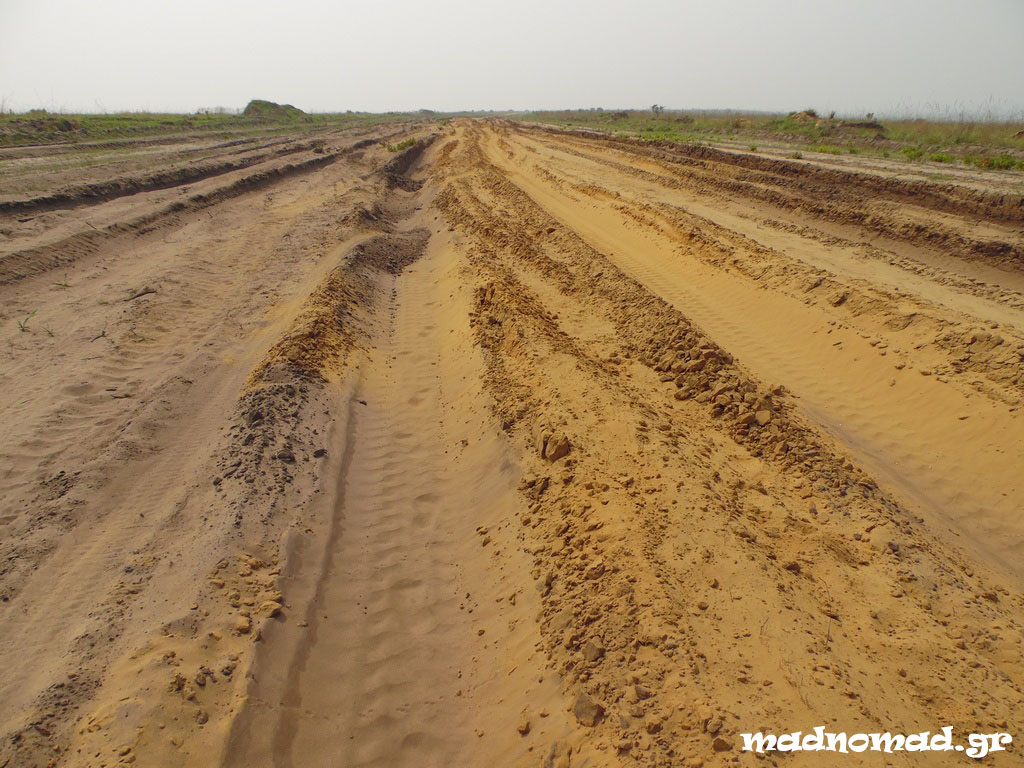
The terrain Christina hates the most: sand, with deep ruts on top of it…
Things were not much easier for me either, as I carry most of our luggage on my motorbike. It is not easy for anyone to balance 220 kg (485 pounds) on such a rough terrain… During those days we would not cover more than 70 kilometres (43 miles) before dusk. It was crucial for us to look for the trails that the locals use to move their overloaded bicycles. These bicycles are so heavily loaded that nobody rides them. Usually they are just being pushed by two or three individuals. That is how most of the goods are being transported to the villages and cities that are located in the jungle, and that’s why their cost is unbelievably high. You can find gas everywhere in jerry cans, sold from 1.7 to 3 euros per litre!

From the first day I noticed something unbelievable on my motorcycle: the front axle’s bracket was cracked! I had no choice but to place it on Christina’s motorbike, as she carries much less weight, praying for it to last…
On the third day on this route, while we were struggling in this hell, we met three local motorcyclists, who suggested us to travel altogether to Tshikapa. During the first five minutes Christina threw herself inside a deep rut and it crossed my mind that the others would be fed up with waiting us and would continue without us. Strangely enough though, after having pulled the motorcycle out of the ditch, Christina was leading the whole team, riding like a true enduro rider! I had never seen her riding like this on the trails and I could not believe my own eyes! We even rode in fourth gear, cornering our XRs on narrow trails. This was one of the parts of this route that I enjoyed riding very much…

The most beautiful place where we wild-camped on this route… We spent almost one hour inside the cool water of this river!
We had become a great team, co-operating immaculately. One of the locals was leading us, as he knew the right trails, Christina was following, so that she could get some help every time she dropped her motorbike, while I was riding at the end of the queue helping the locals whenever they would get stuck with their Chinese motorbikes. We were on a pretty good pace and we managed to cover 110 kilometers (68 miles) that day, arriving in Tshikapa, which was the first town we encountered.

Many parts of this route are almost impassable for a four-wheeler.
On some police roadblock, Christina played her magic tricks once more and we left without having to open our wallet. For our friends, however, it was not that easy… One of the cops untied the luggage from the back of one of the motorbikes and helped himself to a jacket he found, while the owner was looking at the scene helpless without being able to react and I was trying hard to take in what was going on… The Congolese have to deal with such brutal violence coming from the authorities of this country that unfortunately, they live in terror, without anybody reacting in anything. They all know that the police and military officers are authorized, armed mere criminals.

At the house of the cousin of one of the three local motorcyclists with whom we traveled together for a day!
When we arrived in Tshikapa, our friends led us straight to the house of their cousin, in order to spend the night there altogether. Their family was really glad to see them after such a long trip and the women immediately lit up the coals and started cooking. In these countries almost everyday the food staple is a dough-like ball, usually made from cassava or corn flour. They accompany this with relishes made from green leaves, and maybe some fish or meat, if they can afford such a treat. They brought us a bucket of water to take a shower and refresh ourselves after so much sweat and dust stuck on our bodies all those days. Then they laid a piece of foam mattress on the floor for us to sleep…
Η Μπραζαβίλ κι η Κινσάσα είναι οι δυο πιο κοντινές πρωτεύουσες στον κόσμο! Απέχουν μόλις 1,6 χιλιόμετρα και τις χωρίζει μόνο ο Ποταμός Κονγκό. Ωστόσο, η διάσχιση των συνόρων με τη σχεδία που πλέει από τη μια πρωτεύουσα στην άλλη είναι μια από τις πιο δύσκολες στον κόσμο, ειδικά για λευκούς που ταξιδεύουν με δικό τους όχημα. Έτσι αποφασίσαμε να κάνουμε έναν κύκλο 580 χιλιομέτρων, τα περισσότερα από τα οποία ήταν σε χωματόδρομους, με σκοπό να μπούμε στην προβληματική Λαϊκή Δημοκρατία του Κονγκό από έναν μικρό κι απομακρυσμένο συνοριακό σταθμό.
Ακόμη και σ’ εκείνον το μικρό σταθμό δεν άρεσε στους συνοριακούς υπαλλήλους το γεγονός πως είχαμε πάρει τις βίζες μας απ’ το Μπενίν κι όχι από την Ελλάδα. Τους εξηγήσαμε πως ήταν αδύνατον να πάρουμε τις βίζες απ’ τη χώρα μας, αφού είχαμε φύγει από ‘κει πριν έντεκα μήνες, οπότε οποιαδήποτε βίζα θα είχε λήξει. Καθώς αυτοί τηλεφωνούσαν στον ανώτερό τους για να τους πει τι να κάνουν, βράδιαζε κι έτσι κατασκηνώσαμε έξω απ’ το αστυνομικό τμήμα, κυριολεκτικά! Η Χριστίνα μαγείρεψε μια νόστιμη πατατοσαλάτα κι αφού φάγαμε, μπήκαμε στο αντίσκηνό μας.
Κι άλλο σκασμένο λάστιχο…
Το επόμενο πρωί, κι αφού ο διοικητής είχε δώσει την έγκρισή του, σφράγισαν τα διαβατήριά μας κι έτσι μπήκαμε κι επίσημα στη Λαϊκή Δημοκρατία του Κονγκό. Στο Luozi, την επόμενη κωμόπολη που συναντήσαμε, μας ανάγκασαν να δηλωθούμε πάλι στην υπηρεσία αλλοδαπών. Πάλι η ίδια ιστορία… Μας ζητούσαν 40 δολάρια για να μας δώσουν πίσω τα διαβατήριά μας, ύστερα η τιμή έπεσε στο μισό, κι αφού επιμέναμε πως δεν έχουμε χρήματα, μας άφησαν, τελικά, να φύγουμε μετά από δυο ώρες. Αυτή ήταν η χώρα για την οποία είχαμε διαβάσει τόσα… Μέχρι να τη διασχίσουμε μας σταμάτησαν σε 20 μπλόκα και σχεδόν όλοι απαιτούσαν να τους δωροδοκήσουμε.
Τότε ήταν που έμπαινε μπροστά η Χριστίνα… Η Χριστίνα εργαζόταν στην Ελλάδα ως πολιτικός μηχανικός κι αυτό σημαίνει πως σχεδόν κάθε μέρα βρισκόταν στην πολεοδομία. Μετά από τέτοια προϋπηρεσία στις συνδιαλλαγές με διεφθαρμένους και γλοιώδεις δημόσιους υπαλλήλους, καταλαβαίνετε πόσο περίφημα τα πήγαινε με τους Αφρικανούς δημόσιους υπαλλήλους… Τελικά καταφέραμε να διασχίσουμε ολόκληρη τη χώρα χωρίς να χρειαστεί να μπούμε σ’ αυτό το βρώμικο παιχνίδι των δωροδοκιών.
Το πολυτελές κέντρο της πρωτεύουσας
Τρεις μέρες μας πήρε τελικά για να ταξιδέψουμε ανάμεσα στις δυο κοντινότερες πρωτεύουσες του κόσμου! Φτάνοντας στην Κινσάσα, προσπαθούσαμε να τηλεφωνήσουμε στον Christophe και τη Cynthia, τους Βέλγους που θα μας φιλοξενούσαν εκεί. Διαπιστώσαμε, όμως, πως μας είχαν δώσει λάθος τηλεφωνικό αριθμό. Σταματήσαμε κάπου για να σκεφτούμε τι μπορούμε να κάνουμε και τότε άρχισε μια σειρά απίστευτων συμπτώσεων… Μας είδε κάποιος Γάλλος μοτοσυκλετιστής, ο οποίος στα νιάτα του έτρεχε στο Paris – Dakar. Όταν του είπαμε πως θέλουμε να φτάσουμε οδικώς μέχρι το Lubumbashi, στα νότια της χώρας, μας θεώρησε τρελούς και τηλεφώνησε αμέσως σ’ ένα φίλο του, επίσης μοτοσυκλετιστή. Μας έδωσε το τηλέφωνο και βρεθήκαμε να μιλάμε ελληνικά με τον Γιώργο, που τύχαινε να είναι ο ιδιοκτήτης του σπιτιού όπου έμεναν ο Christophe κι η Cynthia!
Στην Κινσάσα παραλάβαμε το Sena Bluetooth Audio Pack, που μας επιτρέπει να ηχογραφούμε στα βίντεό μας τις συνομιλίες που κάνουμε μέσω του συστήματος ενδοεπικοινωνίας!
Ο Γιώργος ήρθε αμέσως να μας πάρει με το Honda CRF 450 του κι εμείς προσπαθούσαμε να συνειδητοποιήσουμε τι συνέβαινε! Τις επόμενες μέρες βρεθήκαμε ανάμεσα σε μια υπέροχη παρέα, που γέμιζε απ’ τα γέλια του Christophe και της Cynthia. Εκεί έπρεπε να οργανωθούμε όσο καλύτερα μπορούσαμε, αφού είχαμε μπροστά μας το κομμάτι του ταξιδιού που αναμενόταν να είναι το δυσκολότερο…
Τα λαμπερά χαμόγελα του Christophe και της Cynthia φώτιζαν τις μέρες μας στη μουντή πρωτεύουσα.
Η Κινσάσα, η πρωτεύουσα της χώρας, απέχει περίπου 2.500 χιλιόμετρα από το Lubumbashi, τη συμπρωτεύουσα. Οι περισσότεροι θεωρούν πως αυτές οι δυο πόλεις δε συνδέονται οδικώς και μετακινούνται μόνο αεροπορικώς ανάμεσά τους. Υπάρχει ένα δίκτυο από δύσβατους χωματόδρομους που διασχίζουν τη ζούγκλα και συνδέουν τις δυο πόλεις, αλλά ελάχιστοι ξένοι ταξιδιώτες τους έχουν δοκιμάσει. Ακόμη λιγότεροι έχουν φτάσει στον προορισμό τους με το όχημά τους σε λειτουργία…
Ο Άκης Τεμπερίδης κι η Βούλα Νέτου είχαν βάλει το Land Rover τους σε αεροπλάνο για να το μεταφέρουν απ’ τη μια μεγαλούπολη στην άλλη και πολύ καλά έκαναν, αφού για ένα τετράτροχο η διαδρομή είναι σχεδόν απροσπέλαστη. Για του λόγου το αληθές, μπορείτε να δείτε πώς καταστράφηκε ένα Land Cruiser μετά από 39 μέρες σ’ αυτήν τη διαδρομή… Κάποιοι Κονγκολέζοι φορτηγατζήδες που οδηγούν ανάμεσα στις δυο πόλεις, χρειάζονται γύρω στους τρεις μήνες για να ολοκληρώσουν τη διαδρομή, αν δεν αντιμετωπίσουν σοβαρή βλάβη στ’ όχημά τους.
Σε κάποια σημεία το τοπίο ήταν μαγευτικό…
Ευτυχώς, η διαδρομή δεν είναι το ίδιο δύσβατη για μια μοτοσυκλέτα. Μερικοί μοτοσυκλετιστές που την έχουν δοκιμάσει, την ολοκλήρωσαν σε μόλις δυο ‘βδομάδες. Ωστόσο, η διαδρομή αυτή έδειξε τα δόντια της στο Στέργιο και τους δυο μοτοσυκλετιστές φίλους του. Από τις πρώτες κιόλας μέρες, εγκατέλειψε ο Γάλλος με τη BMW F800 GS λόγω καμένου συμπλέκτη. Την επόμενη μέρα εγκατέλειψε κι ο Στέργιος με τη Vespa του για τον ίδιο λόγο. Τελικά, καβαλάρης στον προορισμό του έφτασε, μετά από κάποιες βλάβες, μόνο ο Steven μ’ ένα Yamaha XT 125, που προφανώς ήταν το ελαφρύτερο και καταλληλότερο μηχανάκι γι’ αυτήν τη διαδρομή.
Αφού έκανα ένα service στα δυο μας Honda XR 250 κι έλεγξα όλες τις βίδες που πιθανόν να είχαν χαλαρώσει από την εκτεταμένη εκτός δρόμου οδήγηση, αφήσαμε πίσω μας τα παρανοϊκά μποτιλιαρίσματα της πρωτεύουσας. Τα πρώτα 622 χιλιόμετρα ήταν σε άσφαλτο. Από ‘κει και πέρα, όμως, ξεκινούσε το δυσκολότερο κομμάτι της διαδρομής…
Τα φίλτρα αέρος τα βάλαμε μέσα σε καλσόν, που κρατούσε το πολύ χώμα κι έτσι μπορούσαμε να τα καθαρίζουμε εύκολα στη μέση της ζούγκλας! Μια καταπληκτική ιδέα του μηχανικού μας: του Δημήτρη Κατηγιάννη απ’ το NRG.
Η Χριστίνα αντίκρισε ξανά το στοιχείο που μισεί περισσότερο: την άμμο! Στη Σαχάρα είχε κάνει μια αρκετά εκτεταμένη προπόνηση εκατοντάδων χιλιομέτρων, αλλά εκεί δεν ήταν τόσο δύσκολη η οδήγηση, αφού δεν υπήρχαν ροδιές, οπότε μπορούσαμε ν’ αυξήσουμε την ταχύτητά μας και να κινούμαστε άνετα. Ο δρόμος προς την Tshikapa, όμως, ήταν γεμάτος ροδιές από τα φορτηγά, οι οποίες ήταν τόσο βαθιές, που χτυπούσαν οι βαλίτσες μου στα τοιχώματα. Εκείνες τις μέρες πέφταμε γύρω στις πέντε φορές ο καθένας μας. Όπως ήταν αναμενόμενο, η Χριστίνα ζοριζόταν ιδιαίτερα και σε κάποια κομμάτια έπρεπε να παίρνω εγώ τη μοτοσυκλέτα της. Αυτή ήταν κι η συμφωνία άλλωστε: εγώ τους χωματόδρομους κι η Χριστίνα τους μπάτσους 😉
Το στοιχείο που μισεί η Χριστίνα: άμμος και μάλιστα με βαθιές ροδιές…
Τα πράγματα δεν ήταν ευκολότερα για ‘μένα, αφού στη δική μου μοτοσυκλέτα κουβαλώ το μεγαλύτερο μέρος του φορτίου μας. Για κανέναν δεν είναι εύκολο να ισορροπεί 220 κιλά σε τόσο δύσβατα εδάφη… Εκείνες τις μέρες μέχρι να βραδιάσει πάνω από 70 χιλιόμετρα δε μπορούσαμε να καλύψουμε. Το σημαντικότερο εκεί ήταν να βρίσκουμε τα μονοπάτια τα οποία χρησιμοποιούν οι ντόπιοι που κουβαλούν τεράστια φορτία πάνω σε ποδήλατα. Είναι τόσο βαριά φορτωμένα, που κανείς δεν τα καβαλά. Συνήθως τα σπρώχνουν δύο ή τρία άτομα. Έτσι μεταφέρονται τα περισσότερα προϊόντα στις πόλεις και τα χωριά που βρίσκονται μέσα στη ζούγκλα και γι’ αυτό το κόστος τους είναι υπερβολικό. Υπάρχει παντού βενζίνη σε μπετόνια, αλλά πωλείται από 1,7 έως 3 ευρώ ανά λίτρο!
Από την πρώτη κιόλας μέρα, είδα κάτι απίστευτο στη μοτοσυκλέτα μου: είχε ραγίσει η βάση της μπροστινής ρόδας! Αναγκαστικά, την έβαλα στη μοτοσυκλέτα της Χριστίνας, που κουβαλά πολύ λιγότερο βάρος κι ευχόμουν να μη σπάσει ολοκληρωτικά…
Την τρίτη μέρα που παιδευόμασταν μέσα σ’ αυτό το χάος, συναντήσαμε τρεις ντόπιους μοτοσυκλετιστές, οι οποίοι μας πρότειναν να συνεχίσουμε όλοι μαζί μέχρι την Tshikapa. Στα πρώτα πέντε λεπτά η Χριστίνα έπεσε σ’ ένα βαθύ νεροφάγωμα και σκεφτόμουν πως προφανώς οι άλλοι θα βαρεθούν να μας περιμένουν και θα μας αφήσουν. Περιέργως, αφού έβγαλαν τη μοτοσυκλέτα μέσα απ’ το χαντάκι, η Χριστίνα οδηγούσε όλη την ομάδα και μάλιστα με ρυθμούς εντουρά! Δεν την είχα ξαναδεί να οδηγεί έτσι στα μονοπάτια και δε μπορούσα να πιστέψω στα μάτια μου! Μέχρι και τετάρτη βάζαμε και πλαγιάζαμε τα XR πάνω σε στενά μονοπάτια. Ήταν από τα κομμάτια της διαδρομής που το απόλαυσα οδηγικά…
Το πιο όμορφο μέρος όπου κατασκηνώσαμε στη διαδρομή… Μια ώρα καθίσαμε στο δροσερό νεράκι του ποταμού!
Είχαμε γίνει μια πολύ καλή ομάδα και συνεργαζόμασταν άψογα. Ένας από τους ντόπιους πήγε μπροστά για να μας δείχνει τα μονοπάτια, ακολουθούσε η Χριστίνα, την οποία έπρεπε να βοηθούμε όταν έπεφτε, ενώ εγώ έκανα τη σκούπα και βοηθούσα τους ντόπιους που κολλούσαν στην άμμο με τα κινέζικα μηχανάκια τους. Είχαμε πολύ καλό ρυθμό και καταφέραμε να καλύψουμε 110 χιλιόμετρα εκείνη τη μέρα, φτάνοντας στην Tshikapa, την πρώτη πόλη που συναντούσαμε.
Πολλά κομμάτια της διαδρομής είναι σχεδόν απροσπέλαστα για τα τετράτροχα.
Σε κάποιο μπλόκο της αστυνομίας, η Χριστίνα έκανε τα μαγικά της και μας άφησαν ήσυχους χωρίς να βγάλουμε το πορτοφόλι απ’ την τσέπη μας. Για τους φίλους μας, όμως, δεν ήταν τόσο εύκολα τα πράγματα… Ένας μπάτσος έλυσε τα μπαγκάζια από τη μια μοτοσυκλέτα και πήρε ανενόχλητος ένα μπουφάν που βρήκε, ενώ ο ιδιοκτήτης του κοιτούσε τη σκηνή ανήμπορος ν’ αντιδράσει κι εγώ προσπαθούσα να χωνέψω αυτό που έβλεπαν τα μάτια μου… Οι ντόπιοι αντιμετωπίζουν τόσο σκληρή βία από τις αρχές αυτού του τόπου, που δυστυχώς ζουν με τον τρόμο και κανείς δεν τολμά να μιλήσει. Όλοι τους γνωρίζουν πως οι αστυνομικοί κι οι στρατιωτικοί αυτής της χώρας είναι νόμιμοι, ένοπλοι εγκληματίες.
Στο σπίτι του ξαδέρφου των τριών ντόπιων μοτοσυκλετιστών με τους οποίους ταξιδέψαμε για μια μέρα!
Φτάνοντας στην Tshikapa οι φίλοι μας κατευθείαν μας οδήγησαν στο σπίτι ενός ξαδέρφου τους, για να κοιμηθούμε όλοι μαζί εκεί. Οι συγγενείς τους χαίρονταν πολύ που τους ξανάβλεπαν μετά από ένα τόσο μακρινό ταξίδι κι οι γυναίκες άναψαν αμέσως τα κάρβουνα για να ξεκινήσουν το μαγείρεμα. Σ’ αυτές τις χώρες σχεδόν κάθε μέρα φτιάχνουν μπάλες από ζυμάρι, που συνήθως είναι από κασάβα ή καλαμπόκι. Τις συνοδεύουν με σάλτσες από βραστά χόρτα και φύλλα, ίσως ψάρι ή, αν το επιτρέπουν τα οικονομικά, κρέας. Μας έφεραν έναν κουβά νερό, για να βγάλουμε από πάνω μας τον ιδρώτα και το χώμα που είχε κολλήσει όλες αυτές τις μέρες κι ύστερα μας έστρωσαν ένα κομμάτι αφρολέξ στο πάτωμα για να κοιμηθούμε…
Congo: What a politeness!Κονγκό: Μα τι ευγένεια είναι αυτή;
There are two countries sharing the word “Congo” in their name, sharing borders at the same time. The first one is the Republic of the Congo (RC, the former French Congo), usually called “Congo” or “Congo-Brazzaville”, due to the name of its capital city. The second one is also the largest one, the Democratic Republic of the Congo (DRC in English and RDC in French, the former Belgian Congo or Zaire), which is also known as “Congo-Kinshasa”, also due to the name of its capital city. So, the small Congo was first on the list.
Having studied the maps on our GPS, we noted all the remote dirt tracks in Cameroon leading to the border with Congo. There are just a few trucks crossing from there, as the roads are rough, especially when being in the middle of the rainy season. We saw a truck with the one side completely sunken inside some treacherous thick mud, with the truck being on the edge of tipping over! When something like this happens, the rest of the trucks have to sit there and wait for days until they manage to free the first truck. Usually the dirt track is quite narrow and the vegetation around it so thick that the other trucks have no other choice but to wait. Happily, there is usually enough space for our motorcycles to go through.

Riding through the isolated and stunning jungle, on the way to the border with Congo.
Some friendly border officers stamped our documents, sponsored by ELPA, and they even suggested us to camp there, as it was already dark. It was very amusing to listen to Christina negotiating with the custom officers while I was pitching the tent just in front of them! The next day we had rain for breakfast. While I was riding in a somewhat high speed, in fourth gear, suddenly at some corner I saw slippery mud on the road. Without any time to react, I found my motorcycle sliding on the ground and myself sliding behind it! For the first time in my life I realized how it feels like to drop the motorcycle and slide on the road wondering when and where I will end up…
The motorcycle slid while winding for about ten meters and I ended up behind it. The throttle was stuck and the engine was screaming! I got up immediately and pressed the kill switch. At that time Christina arrived on the spot and together we picked up the motorbike. There was mud thrown even inside my helmet. I was literally spitting it out of my mouth. Luckily, I was not injured or in pain whatsoever. I had been sliding on my butt, while my back had not touched the ground. The left pannier of my motorcycle had got another dent on its bottom edge but that was just about it. It was such a close shave… The only problem was that I was like a pig, covered in mud.

For the first time in my life I realized how it feels like to drop the motorcycle and slide on the road wondering when and where I will end up…
In the area around Souanké we found the deep, slippery mud that we expected. Some parts were full of ruts from the trucks we encountered every once in a while abandoned inside the mud. No need to say that we were moving with zero speed, as I had to get off my motorcycle and push Christina’s that didn’t have enough traction, even though we had reduced the pressure of the tyres. Christina dropped her motorbike five times those days and I dropped mine five times as well, while it took us three hours to cross those 30 km (19 miles) of deep mud.

One of the five falls I had those days…
What impressed us the most was that whenever there were people close by, they would dip bare-feet inside the mud in order to help us. They didn’t even ask us anything in return! There we found also one local stuck in mud with his Chinese motorbike. I had to run from Christina’s motorcycle to the motorcycle of the friendly Congolese and help by pushing.

A lot of mud!
The biggest part of the road to Ouesso was a graded dirt road, which was not so slippery and we could ride more comfortably. When the rain stopped, we really enjoyed a part of the lush jungle, riding through an amazing route where we were face-to-face with a big, colourful, tropical bird!

While enjoying a beautiful route inside the jungle, we were face-to-face with this awesome tropical bird!
On the third day we arrived in Ouesso, the northernmost town in Congo, situated on a scenic part of the bank of Sangha River. From there we headed south. In some places there was well-graded dirt road waiting for the tar and in other the Chinese workers had already laid the blacktop. In the town of Makoua we crossed the Equator! There was no sign informing us about that as no tourists ever go there. I was looking at the coordinates on the GPS and there was a moment when the latitude turned zero!

We are crossing the Equator! The latitude turned zero on the GPS!
To us, the Equator was more than a line on the map. The most important was that it marked our escape from the rainy season that had already begun in the African countries north of the Equator and it had been quite annoying for the last two months. South of the Equator it is time for the dry season to begin, the one that we had missed so much… We could not imagine, however, how radical the change of the weather would be. Before crossing the Equator it was raining everyday, while we haven’t seen a single drop from the moment we crossed it! No need to say, of course, that from the first minute we loved the southern hemisphere 😉

We are on the Equator! Christina’s motorcycle is on the northern hemisphere, while mine is on the southern one!
Covering daily around 350 km (217 miles) on boring tarred roads, we headed to the capital of Congo. We were really surprised to find friendly police officers in this country. Nobody even implied anything about a bribe! This does not mean, of course, that they don’t demand some bribing from the locals. The locals in these countries never get away without paying something to the authorities.

Atelier squeezed in between the dirt tracks of Brazzaville.
In Brazzaville we were hosted by Chantal, a French teacher who leaves there. At the French Institute of the city we had the chance to attend a concert of Fredy Massamba, a famous Congolese singer. The locals inside the amphitheatre were dancing while applauding and cheering! That’s how every musical performance ends in Africa, no matter if it takes place in the middle of the street or in some music hall.

The map of Africa, made out of portraits of the dictators who ruled or are currently ruling its countries.
We were surprised to find out that Congo is really misunderstood because of its neighboring country, the Democratic Republic of the Congo. Very few travelers visit these countries and there is not enough information around. We thought the picture would be the same in both Congos but we realized that even a white woman can wander around Brazzaville alone at night without being threatened. We expected to find corrupted officers and aggressive people but instead we met friendly policemen and people with a politeness that we had longed for so much…
Here you can watch the video about our adventure in Congo (with English subtitles):
Soundtracks (music from Congo):
Fredy Massamba – Sanzasonyk
Fredy Massamba – Ntoto
Jehf Biyeri – Munsinsa (Instrumental)
Lang’i – La Riviere
Lang’i – Butaneno
Υπάρχουν δύο χώρες που χρησιμοποιούν τη λέξη “Κονγκό” στ’ όνομά τους και μάλιστα γειτονεύουν. Η μια είναι η Δημοκρατία του Κονγκό (RC, πρώην Γαλλικό Κονγκό), που συνήθως αποκαλείται απλά “Κονγκό” ή “Κονγκό-Μπραζαβίλ”, λόγω της πρωτεύουσάς της. Η άλλη είναι και η μεγαλύτερη, η Λαϊκή Δημοκρατία του Κονγκό (DRC στ’ αγγλικά και RDC στα γαλλικά, πρώην Βελγικό Κονγκό ή Ζαΐρ), η οποία μερικές φορές αποκαλείται “Κονγκό-Κινσάσα”, αφού η Κινσάσα είναι η πρωτεύουσά της. Εμείς διασχίσαμε αρχικά το μικρό Κονγκό.
Συμβουλευόμενοι τους χάρτες που έχουμε στο GPS μας, βρήκαμε τους ερημικούς χωματόδρομους του Καμερούν που οδηγούν στα σύνορα με το Κονγκό. Μόνο λίγα φορτηγά περνούν από ‘κει, αφού οι δρόμοι είναι δύσβατοι, ιδιαίτερα κατά τη βροχερή περίοδο, καταμεσής της οποίας βρισκόμασταν. Η μια πλευρά ενός φορτηγού είχε βυθιστεί σ’ ένα βούρκο, ο οποίος δε φαινόταν και το φορτηγό κόντευε ν’ ανατραπεί! Όταν συμβαίνει αυτό, τα υπόλοιπα φορτηγά πρέπει να περιμένουν εκεί για μέρες μέχρι ν’ απεγκλωβιστεί το πρώτο φορτηγό. Συνήθως ο χωματόδρομος είναι στενός κι η βλάστηση τριγύρω πυκνή, οπότε δεν υπάρχει διέξοδος για τ’ άλλα φορτηγά. Ευτυχώς, εμείς με τις μοτοσυκλέτες μπορούσαμε να περάσουμε.
Οδηγώντας στην ερημική και πανέμορφη ζούγκλα προς τα σύνορα με το Κονγκό.
Οι φιλικότατοι συνοριακοί υπάλληλοι σφράγισαν τα έγγραφα που μας χορήγησε η ΕΛΠΑ και μάλιστα μας πρότειναν να κατασκηνώσουμε εκεί, αφού είχε βραδιάσει. Είχε πλάκα ν’ ακούω τη Χριστίνα να συνδιαλέγεται με τους τελωνειακούς την ώρα που εγώ έστηνα τ’ αντίσκηνο εκεί μπροστά! Την επόμενη μέρα ξεκινήσαμε με βροχή. Καθώς οδηγούσα κάπως γρήγορα, με τετάρτη, σε κάποια στροφή είδα ξαφνικά πως είχε γλιστερή λάσπη. Προτού προλάβω ν’ αντιδράσω, έβλεπα τη μοτοσυκλέτα μου να σέρνεται στο έδαφος, ενώ εγώ σερνόμουν από πίσω της! Πρώτη φορά στη ζωή μου ένιωθα πώς είναι να πέφτεις απ’ τη μοτοσυκλέτα, να σέρνεσαι στο δρόμο και ν’ αναρωτιέσαι πότε και πού θα σταματήσεις…
Η μοτοσυκλέτα σύρθηκε για δέκα μέτρα περίπου, περιστράφηκε κι εγώ σταμάτησα από πίσω της. Είχε κολλήσει το γκάζι κι ο κινητήρας ούρλιαζε! Σηκώθηκα αμέσως και πάτησα το killswitch. Εκείνη την ώρα ήρθε κι η Χριστίνα, οπότε σηκώσαμε μαζί τη μοτοσυκλέτα μου. Η λάσπη είχε πεταχτεί ακόμη και μέσα στο κράνος μου. Την έφτυνα απ’ το στόμα μου. Ευτυχώς, δεν είχα χτυπήσει και δεν πονούσα καθόλου. Σερνόμουν με τον κώλο, αλλά η πλάτη μου δεν ακούμπησε στο έδαφος. Η αριστερή βαλίτσα της μοτοσυκλέτας μου απόκτησε άλλο ένα βαθούλωμα στην κάτω γωνία της, αλλά αυτό ήταν όλο. Φθηνά τη γλύτωσα… Το μόνο πρόβλημα ήταν πως είχα γίνει σα γουρούνι μες στις λάσπες.
Πρώτη φορά στη ζωή μου ένιωθα πώς είναι να πέφτεις απ’ τη μοτοσυκλέτα, να σέρνεσαι στο δρόμο και ν’ αναρωτιέσαι πότε και πού θα σταματήσεις…
Στην περιοχή γύρω απ’ το Souanké συναντήσαμε τη βαθιά, γλιστερή λάσπη που περιμέναμε. Κάποια κομμάτια ήταν γεμάτα ροδιές από τα φορτηγά που βλέπαμε κάθε λίγο παρατημένα μέσα στη λάσπη. Φυσικά, κινούμασταν σημειωτών, αφού έπρεπε να κατεβαίνω απ’ τη μοτοσυκλέτα μου και να σπρώχνω τη μοτοσυκλέτα της Χριστίνας, που δεν είχε αρκετή πρόσφυση παρόλο που είχαμε μειώσει την πίεση των ελαστικών. Εκείνες τις μέρες έπεσε πέντε φορές η Χριστίνα κι άλλες τόσες εγώ, ενώ για να διασχίσουμε εκείνα τα 30 χλμ. βαθιάς λάσπης, μας πήρε τρεις ώρες.
Μια από τις πέντε πτώσεις που είχα εκείνες τις μέρες…
Αυτό που μας έκανε εντύπωση ήταν πως όταν ήμασταν κοντά σε κόσμο, αυτοί βουτούσαν ξυπόλυτοι μέσα στις λάσπες και μας βοηθούσαν. Μάλιστα δε μας ζήτησαν τίποτα για τις υπηρεσίες τους. Ήταν εκεί κι ένας ντόπιος που είχε κολλήσει στη λάσπη με το κινέζικο μηχανάκι του, οπότε έτρεχα να σπρώχνω μια τη μοτοσυκλέτα της Χριστίνας και μια τη μοτοσυκλέτα του φιλικού Κονγκολέζου.
Πολύ λάσπη!
Το μεγαλύτερο κομμάτι του δρόμου προς το Ouesso είχε πατημένο χώμα, που δε γλιστρούσε τόσο κι έτσι οδηγούσαμε πιο άνετα. Μάλιστα, όταν σταμάτησε η βροχή, απολαύσαμε ιδιαίτερα ένα κομμάτι της καταπράσινης ζούγκλας οδηγώντας σε μια πανέμορφη διαδρομή, όπου ήρθαμε πρόσωπο με πρόσωπο μ’ ένα μεγάλο, χρωματιστό, τροπικό πουλί!
Καθώς απολαμβάναμε μια ωραία διαδρομή μέσα στη ζούγκλα, ήρθαμε πρόσωπο με πρόσωπο μ’ αυτό το πανέμορφο τροπικό πουλί!
Την τρίτη μέρα φτάσαμε στο Ouesso, τη βορειότερη πόλη του Κονγκό, που βρίσκεται σ’ ένα γραφικό κομμάτι της όχθης του Ποταμού Sangha. Από ‘κει πήραμε το δρόμο προς τα νότια. Αλλού ήταν στρωμένος χωματόδρομος που περίμενε την άσφαλτο κι αλλού τα κινέζικα συνέργεια είχαν ήδη απλώσει το μαύρο τάπητα. Στην κωμόπολη Makoua διασχίσαμε τον ισημερινό! Δεν υπήρχε καμιά πινακίδα που να το ανακοινώνει, αφού τουρίστες δεν παν εκεί. Έβλεπα τις συντεταγμένες στο GPS και κάποια στιγμή το γεωγραφικό πλάτος μηδενίστηκε!
Διασχίζουμε τον ισημερινό! Το γεωγραφικό πλάτος μηδενίστηκε στο GPS!
Για μας ο ισημερινός δεν είναι απλά ένα σημείο στο χάρτη. Το σημαντικότερο είναι πως σηματοδοτεί την απόδρασή μας από τη βροχερή περίοδο, που είχε ξεκινήσει στις αφρικανικές χώρες βόρεια του ισημερινού και μας ταλαιπώρησε κάπως τους τελευταίους δυο μήνες. Νότια του ισημερινού είναι ο καιρός που ξεκινά η ξηρή περίοδος, αυτή που τόσο μας έλειψε… Δε μπορούσαμε, όμως, να φανταστούμε πόσο απότομα θ’ άλλαζε ο καιρός. Μέχρι να φτάσουμε στον ισημερινό έβρεχε κάθε μέρα, ενώ από τη μέρα που τον διασχίσαμε δεν έχουμε δει ούτε σταγόνα! Περιττό να πούμε, λοιπόν, πως λατρέψαμε το νότιο ημισφαίριο απ’ την πρώτη στιγμή 😉
Βρισκόμαστε πάνω στον ισημερινό! Η μοτοσυκλέτα της Χριστίνας είναι στο βόρειο ημισφαίριο, ενώ η δική μου στο νότιο!
Καλύπτοντας καθημερινά γύρω στα 350 χλμ. στη βαρετή άσφαλτο, κατευθυνόμασταν προς την πρωτεύουσα του Κονγκό. Διαπιστώσαμε έκπληκτοι πως οι αστυνομικοί σ’ αυτήν τη χώρα είναι φιλικοί, ενώ κανείς δε μας έκανε ούτε νύξη για δωροδοκία! Αυτό, βέβαια, δε σημαίνει πως δεν απαιτούν δωροδοκίες από τους ντόπιους. Οι ντόπιοι σ’ αυτές τις χώρες ποτέ δε γλιτώνουν απ’ τα νύχια των αρχών αν δε δώσουν το κατιτίς.
Ατελιέ χωμένο στους χωματόδρομους της Μπραζαβίλ.
Στη Μπραζαβίλ μας φιλοξένησε η Chantal, μια Γαλλίδα εκπαιδευτικός που ζει εκεί. Στο Γαλλικό Ινστιτούτο της πόλης είχαμε την ευκαιρία να παρακολουθήσουμε και μια συναυλία του Fredy Massamba, ενός διάσημου Κονγκολέζου μουσικού. Οι ντόπιοι μέσα στο αμφιθέατρο είχαν σηκωθεί απ’ τα καθίσματά τους και χόρευαν, ενώ ζητωκραύγαζαν! Κάπως έτσι καταλήγει κάθε μουσικό δρώμενο στην Αφρική, είτε λαμβάνει χώρα στους δρόμους είτε σε κάποιο μέγαρο μουσικής.
Ο χάρτης της Αφρικής φτιαγμένος από προσωπογραφίες δικτατόρων που κυβέρνησαν ή κυβερνούν τις χώρες της.
Έκπληκτοι διαπιστώσαμε πως το Κονγκό είναι παρεξηγημένο εξαιτίας της γείτονας χώρας, της Λαϊκής Δημοκρατίας του Κονγκό. Ελάχιστοι ταξιδιώτες επισκέπτονται αυτές τις χώρες κι έτσι δε βρίσκει κανείς επαρκείς πληροφορίες. Νομίζαμε πως επικρατεί η ίδια κατάσταση και στα δυο Κονγκό, αλλά είδαμε πως ακόμη και μια λευκή γυναίκα μπορεί να κινείται μόνη της τη νύχτα στη Μπραζαβίλ χωρίς να απειλείται. Περιμέναμε να συναντήσουμε διεφθαρμένα όργανα της “τάξης” κι επιθετικούς κατοίκους, αλλά γνωρίσαμε μόνο φιλικούς αστυνομικούς κι ανθρώπους με μια ευγένεια που μας είχε λείψει…
Εδώ μπορείτε να παρακολουθήσετε το βίντεο σχετικά με την περιπέτειά μας στο Κονγκό:
Soundtracks (κονγκολέζικη μουσική):
Fredy Massamba – Sanzasonyk
Fredy Massamba – Ntoto
Jehf Biyeri – Munsinsa (Instrumental)
Lang’i – La Riviere
Lang’i – Butaneno
Cameroon: Africa in miniature!Καμερούν: Η Αφρική σε μικρογραφία!
Entering Cameroon we were looking forward to visit the mountains in the Northwest Province and the notorious Ring Road! Indeed, the scenery deserved all the difficult time that we had due to the rainy season in these countries. We had missed the mountains so much, as well as the cool weather! After having spent so many months melting under the sun, we stayed in Bamenda a whole week, just to remember how it feels like to sleep under a blanket! My God, what a bliss…

How could I resist taking a dip in Lake Awing, located on an altitude of 2,080 meters (6,824 ft)? (Photo: Caroline te Pas)
Along with our friendly hostess, Caroline, we made quite a few excursions in the area around. We visited lakes, waterfalls, lush mountains, as well as a few traditional palaces of different tribes. In the Northwest Province, they have a profound respect for the chiefs, who, even today, hold strong power over the tribes. When somebody meets a chief, handshaking is forbidden. He must clap his hands three times and then talk to the chief. Some of these chiefs have hundreds of wives! In these countries polygamy is quite common. Some women have kids of different fathers, while they raise them all by themselves, as many men do not live with the rest of the family.

Each and every one of the 61 elaborated columns of this building, where the nine wise men of the kingdom of Bandjoun gather, is distinct.
Riding on the Ring Road we were crossing through lush, enchanting mountains… On one side we could see waterfalls while on the other we enjoyed the views from above! Heading to the south, we went to Douala in order to meet up with an old friend of mine, Dawn. She is an American teacher who works around the world. Six years ago she had hosted me in Kyrgyzstan. We had kept in touch and I knew that now she is teaching at the American International School of Douala. So, we could not miss the chance to meet again.

The sun sets behind Mount Cameroon (4,095 m / 13,435 ft), the highest mountain in West Africa.
From Douala, we made a two-day excursion to Limbe, in order to enjoy the black, volcanic beaches on the foot of Mount Cameroon. In the morning we were swimming in the Atlantic and in the midday we were already on the lower part of the highest mountain in West Africa, which reaches 4,095 meters (13,435 ft). In Limbe we were hosted by Ebai, a friendly local guy who rents a small room and insisted to leave it all to us while he would sleep over a friend of his.

Some of the tens of fishing boats that moor in Limbe.
Having arrived back to Douala on my motorcycle, we were stopped by some municipal policemen, who are scattered around the city and stop the passing drivers, sometimes even by force, in order to gain some money out of them. We were lucky enough not to have to bribe them, as we played fool tourists. Mysteriously enough, however, my motorcycle would not start… I thought he was probably annoyed by the cops too. So, I took him in the shadow, let him cool down a little bit, but he turned out to be really stubborn. We had almost arrived at Dawn’s, so I decided to start pushing him. Of course, it took me more than half an hour in order to cover these two and a half kilometers (1.6 miles).

Christina is training for cowgirl! (Photo: Caroline te Pas)
I thought that maybe the engine was overheated in the traffic jam and some valve had remained open. Indeed, using the kick-starter I could tell that the compression inside the cylinder was not enough. Strangely enough, though, the clearance in the valves was the right one. I changed sparkplug, fuel filter, even carburetor! The engine, however, would not start. Inside the carburetor I noticed pieces of soot.
I could not understand what was going on and my only chance was my mechanic in Greece, Dimitris Katigiannis from NRG. He opened the box with his magic tricks and picked out the one that worked for us: he told me to increase extremely the clearance of the valves and push the motorcycle in order to jump-start it. At last, I could hear the familiar music of my engine again! I restored the clearance of the valves at the right level, changed the oil of the engine and since then everything works properly again. Maybe it was some piece of dirt after all, keeping one of the valves open.

The school bags of the pupils in the countryside are made out of bamboo and they carry them hanging against their forehead.
Arriving in the capital of the country, Yaoundé, we met up with Dawn who had caught a bus from Douala. For a weekend we became part of Ascovime, a volunteering group of doctors and medicine students who visit remote villages and offer their invaluable services to those in real need. As we weren’t qualified enough, we took on the packaging of the pills in the right dosage.
When we completed our task it was time to visit the operating theater. It was nothing fancy: just a room with four walls, a small table to place the tools, a bed for the patients to lie down and lights powered by a generator. No need to say that inside the room you could see all kinds of insects flying around, while from time to time some geckos would make their appearance on the walls. Africans, however, adore geckos, as they eat the insects.

Hundreds of patients arrive from the nearby settlements in order to get examined free of charge by the volunteers of Ascovime.
It was our first time watching a surgery taking place and it was quite shocking. 70 % of the operations carried out in these countries are in the abdominal area. Africans use to bend their back without bending their knees at all. In these way, during the hard agricultural work, the belly is the one to take all the pressure, which creates a lot of problems there. Although adults were being operated under just local anaesthesia, there was not even a whisper coming out of their mouth. Georges, the Cameroonian founder of Ascovime, kept operating during the whole night, as the patients were too many. He was working sleepless for more than 48 hours! This is something that he does three out of four weekends every month, while during the week he is working at the main hospital of the capital. This man is really extraordinary and we feel really honoured to having met him. He totally deserved being awarded from CNN as one of the ten heroes of our world.

Georges is a true hero… For two whole days he was operating sleepless and without any profit every villager that was in need!
When we returned to the capital, unfortunately something bad happened. We were by Christina’s motorcycle on our way to Yoann’s place, where we were being hosted. I was the one driving while Christina was sitting behind me. It was dark and it was raining. On some main square we got trapped in the traffic jam. I heard Christina shouting and I asked her what was the matter but she would not reply. Then I saw somebody running through the cars and the crowd and I began to realize what had happened. Christina told me that somebody was picking her backpack and when she took notice of him, he started running. She was laughing because her backpack is always in such a mess that it is hard even for her to find anything in there, let alone for the thief. But he who laughs last, laughs best… Christina didn’t know that the camera was in her backpack. Unfortunately it was not there any more! The thief had already snatched it and obviously he was not running empty-handed…

In the capital’s downtown traffic is often chaotic. It was there where somebody took the opportunity and relieved us from our camera 🙁
It is the third time during the trip that Christina is being mugged. In Western Sahara and in Ghana we had managed to find the little thieves and take our cell phones back. This time, however, there was not much we could do, so I don’t have my good photo camera with me any more… Don’t worry, that doesn’t mean that you will be left without photos. We had to buy a cheap camera but its quality is obviously much lower.

Yaoundé is one of the most pleasant African capitals we have visited, built on seven hills.
It was time for the hard road to the two Congos. The next two months are expected to be the most demanding of our trip, as we will have to cross the vast jungle through some harsh off-road routes, where some of the most corrupted policemen of our world flourish… The road was tarred until Sangmélima but from there dirt, turning into mud when it’s raining, was abundant.

Cooking under the starry sky in the jungle…
It was there where Christina found her race: the Pygmies! They are some friendly and welcoming natives in these areas, most of them on Christina’s height. She was delighted to meet them in person without having to look up to see them! After two days in the verdant jungle we reached the border with Congo. We were leaving Cameroon, having spent 39 days in this beautiful country, that finally took the second place in our heart, after Guinea of course!
Here you can watch the video about our trip in Cameroon (with English subtitles):
Soundtracks (Cameroonian music):
Francis Bebey – Bissao
Henri Dikongué – We nde mba
Balafons & African Drums
Francis Bebey – Akwaaba
Francis Bebey – Guinea
Francis Bebey – Di Sengi
Μπαίνοντας στο Καμερούν ανυπομονούσαμε να επισκεφτούμε τα βουνά της Βορειοδυτικής Επαρχίας και τον περίφημο Ring Road! Πράγματι, τα τοπία μας αποζημίωσαν για την ταλαιπωρία που συνεπάγεται η βροχερή περίοδος σ’ αυτές τις χώρες. Μας είχαν λείψει τα βουνά κι ειδικά η δροσιά τους! Μετά από τόσους μήνες που λιώναμε στη ζέστη, μείναμε στη Bamenda μια ολόκληρη ‘βδομάδα, για να θυμηθούμε πώς είναι να κοιμόμαστε με κουβέρτα! Τι απόλαυση, Θεέ μου…
Πώς ν’ αντισταθώ σε μια βουτιά στη Λίμνη Awing στα 2.080 μέτρα υψόμετρο; (Φωτογραφία: Caroline te Pas)
Μαζί με την οικοδέσποινά μας, τη συμπαθητική Caroline, κάναμε αρκετές βόλτες στις τριγύρω περιοχές. Επισκεφτήκαμε λίμνες, καταρράκτες, καταπράσινα βουνά, αλλά και παραδοσιακά παλάτια διάφορων φυλών. Στη Βορειοδυτική Επαρχία σέβονται ιδιαίτερα τους φυλάρχους τους, που έχουν ισχυρή εξουσία μέχρι σήμερα. Όταν συναντά κανείς ένα φύλαρχο, απαγορεύεται να του κάνει χειραψία. Πρέπει να χτυπήσει τρεις φορές παλαμάκια κι ύστερα να του μιλήσει, αν του δοθεί ο λόγος. Πολλοί απ’ αυτούς τους φυλάρχους έχουν εκατοντάδες γυναίκες! Η πολυγαμία σ’ αυτές τις χώρες είναι συνηθισμένη. Κάποιες γυναίκες έχουν παιδιά από διάφορους πατέρες, ενώ μεγαλώνουν μόνες τους τα παιδιά, αφού ο άντρας, πολλές φορές, δε μένει με την υπόλοιπη οικογένεια.
Καθένας από τους 61 περίτεχνους στύλους του κτιρίου όπου συγκεντρώνονται οι εννιά σοφοί του βασιλείου του Bandjoun είναι διαφορετικός.
Οδηγώντας στο Ring Road περνούσαμε από καταπράσινα βουνά που μας μάγεψαν… Στη μια πλευρά βλέπαμε μεγάλους καταρράκτες και στην άλλη απολαμβάναμε τη θέα από ψηλά! Κατευθυνόμενοι προς το νότο, πήγαμε στη Douala μόνο και μόνο για να συναντήσουμε μια παλιά μου φίλη, τη Dawn. Είναι μια Αμερικανίδα καθηγήτρια που διδάσκει ανά τον κόσμο. Πριν έξι χρόνια μ’ είχε φιλοξενήσει στο Κυργιζστάν. Είχαμε κρατήσει επαφή κι ήξερα πως τώρα διδάσκει στο Αμερικανικό Κολλέγιο της Douala, οπότε δε χάσαμε την ευκαιρία να συναντηθούμε και πάλι.
Ο ήλιος βασιλεύει πίσω απ’ το Όρος Καμερούν (4.095 μ.), το ψηλότερο βουνό της Δυτικής Αφρικής.
Από τη Douala κάναμε και μια διήμερη εκδρομή στο Limbe, για ν’ απολαύσουμε τις μαύρες, ηφαιστειακές παραλίες στους πρόποδες του Όρους Καμερούν. Το πρωί κάναμε μπανάκι στον Ατλαντικό και το μεσημέρι είχαμε ανέβει στα χαμηλά του ψηλότερου βουνού της Δυτικής Αφρικής, που φτάνει τα 4.095 μέτρα. Στο Limbe μας φιλοξένησε ο Ebai, ένας φιλικός ντόπιος που νοίκιαζε ένα μικρό δωμάτιο κι επέμενε να τ’ αφήσει σ’ εμάς κι αυτός να κοιμηθεί σε κάποιο φίλο του.
Μερικές απ’ τις δεκάδες ψαρόβαρκες που αγκυροβολούν στο Limbe.
Επιστρέφοντας στη Douala με τη μοτοσυκλέτα μου, μας σταμάτησαν κάποιοι δημοτικοί αστυνομικοί, που βρίσκονται διάσπαρτοι στην πόλη και σταματούν ακόμη και βίαια τους διερχόμενους οδηγούς, για να τους αποσπάσουν χρήματα. Εμείς γλυτώσαμε χωρίς να χρειαστεί να τους δωροδοκήσουμε, αφού κάναμε τους χαζούς τουρίστες. Περιέργως, όμως, η μοτοσυκλέτα μου δεν έπαιρνε μπρος με τίποτα… Σκέφτηκα πως θα την ενόχλησαν κι αυτήν οι μπάτσοι. Την πήγα παραπέρα, στη σκιά, την άφησα να κρυώσει, αλλά αυτή είχε πεισμώσει. Είχαμε σχεδόν φτάσει στο σπίτι της Dawn, οπότε αποφάσισα ν’ αρχίσω να τη σπρώχνω. Βέβαια, μου πήρε πάνω από μισή ώρα για να τη μεταφέρω δυόμισι χιλιόμετρα παραπέρα.
Η Χριστίνα προπονείται για καουμπόισσα! (Φωτογραφία: Caroline te Pas)
Σκέφτηκα πως θα είχε ζεσταθεί ο κινητήρας μέσα στην κίνηση και θα έμεινε ανοιχτή καμιά βαλβίδα. Πράγματι, από τη μανιβέλα καταλάβαινα πως η συμπίεση μέσα στον κύλινδρο δεν είναι αρκετή. Περιέργως, όμως, το διάκενο των βαλβίδων ήταν σωστό. Άλλαξα μπουζί, φίλτρο βενζίνης, ακόμη και καρμπιρατέρ! Ο κινητήρας, όμως, δεν έπαιρνε μπρος. Στο καρμπιρατέρ πρόσεξα πως υπήρχαν κομμάτια μάκας.
Δεν καταλάβαινα τι συμβαίνει κι η μόνη σωτηρία ήταν ο μηχανικός μου στην Ελλάδα, ο Δημήτρης Κατηγιάννης του NRG. Άνοιξε το κουτί με τα μαγικά του κόλπα και βρήκε κάτι που έκανε για μας: μου είπε ν’ αυξήσω υπερβολικά το διάκενο των βαλβίδων και να σπρώξουμε τη μοτοσυκλέτα για να τη βάλουμε μπρος σκαστή. Επιτέλους, άκουγα και πάλι τη γνώριμη μουσική του κινητήρα μου! Επανέφερα το διάκενο των βαλβίδων στο σωστό επίπεδο, άλλαξα το λάδι του κινητήρα κι έκτοτε όλα λειτουργούν άψογα και πάλι. Ίσως τελικά κάποιο σκουπιδάκι να κρατούσε μια βαλβίδα ανοιχτή.
Οι τσάντες των μαθητών στην επαρχία είναι φτιαγμένες από μπαμπού και τις στηρίζουν στο μέτωπο.
Φτάνοντας στην πρωτεύουσα της χώρας, τη Yaoundé, συναντήσαμε εκεί τη Dawn, που είχε πάρει λεωφορείο απ’ τη Douala. Για ένα σαββατοκύριακο γίναμε μέρος της Ascovime, μιας ομάδας εθελοντών γιατρών και φοιτητών της ιατρικής, που επισκέπτονται απομακρυσμένα χωριά και προσφέρουν τις πολύτιμες υπηρεσίες τους στους ντόπιους που πραγματικά τις έχουν ανάγκη. Εμείς, αφού δεν έχουμε ιατρικές γνώσεις, αναλάβαμε να πακετάρουμε τα χάπια και να γράφουμε τη σωστή δοσολογία.
Όταν ολοκληρώσαμε την εργασία μας, μπήκαμε στο χειρουργικό δωμάτιο. Μη φανταστείτε τίποτα ιδιαίτερο: ένα δωμάτιο με τέσσερις τοίχους, ένα τραπεζάκι για τα εργαλεία, ένα κρεβάτι για τους ασθενείς και φώτα που λειτουργούσαν με τη βοήθεια μιας γεννήτριας. Βέβαια, μέσα στο δωμάτιο πετούσε κάθε λογής έντομο, ενώ πότε-πότε έδινε το παρόν και καμιά σαύρα στους τοίχους. Τις σαύρες, όμως, τις λατρεύουν οι Αφρικανοί, γιατί τρων τα έντομα.
Εκατοντάδες ασθενείς έρχονται από τους γειτονικούς οικισμούς για να εξεταστούν δωρεάν από τους εθελοντές της Ascovime.
Πρώτη φορά παρακολουθούσαμε εγχείρηση κι ήταν ανατριχιαστικό. Το 70 % των επεμβάσεων εδώ γίνεται στην κοιλιακή χώρα. Οι Αφρικανοί συνηθίζουν να σκύβουν γέρνοντας τη μέση τους, χωρίς να λυγίζουν καθόλου τα γόνατά τους. Έτσι στις σκληρές αγροτικές δουλειές πιέζεται πάντα η κοιλιά και δημιουργούνται ένα σωρό προβλήματα εκεί. Οι ενήλικες εγχειρίζονται με τοπική αναισθησία μόνο και παρόλ’ αυτά δεν ακούγεται ούτε τσιμουδιά απ’ το στόμα τους. Ο Georges, ο Καμερουνέζος ιδρυτής της Ascovime, συνέχισε τις επεμβάσεις καθ’ όλη τη διάρκεια της νύχτας, αφού οι ασθενείς ήταν πάμπολλοι. Εργαζόταν άγρυπνος για πάνω από δυο εικοσιτετράωρα! Αυτό το κάνει τρία από τα τέσσερα σαββατοκύριακα κάθε μήνα, ενώ τις καθημερινές εργάζεται στο κεντρικό νοσοκομείο της πρωτεύουσας. Αυτός ο άνθρωπος είναι σπουδαίος και νιώθουμε μεγάλη τιμή που τον γνωρίσαμε. Δίκαια βραβεύτηκε από το CNN ως ένας από τους δέκα ήρωες του κόσμου μας.
Ο Georges είναι πραγματικά ένας ήρωας… Επί δύο μερόνυχτα εγχείριζε άγρυπνος και αφιλοκερδώς τους χωρικούς που είχαν την ανάγκη του!
Όταν επιστρέψαμε στην πρωτεύουσα, συνέβη κάτι άσχημο, δυστυχώς. Είχαμε πάρει τη μοτοσυκλέτα της Χριστίνας κι γυρίζαμε στο σπίτι του Yoann, που μας φιλοξενούσε. Εγώ οδηγούσα, ενώ η Χριστίνα καθόταν από πίσω μου. Είχε βραδιάσει κι έβρεχε. Σε κάποια κεντρική πλατεία βρεθήκαμε παγιδευμένοι ανάμεσα στα μποτιλιαρισμένα αυτοκίνητα. Άκουσα τη Χριστίνα να φωνάζει και τη ρώτησα τι συνέβη, αλλά δεν απαντούσε. Είδα κάποιον να τρέχει ανάμεσα στ’ αυτοκίνητα και τον κόσμο κι άρχισα να καταλαβαίνω τι έγινε. Η Χριστίνα μου ‘πε πως κάποιος σκάλιζε την τσάντα της και μόλις τον πήρε χαμπάρι, εκείνος άρχισε να τρέχει. Γελούσε γιατί η τσάντα της είναι πάντα τόσο ακατάστατη, που ούτε η ίδια δε μπορεί να βρει κάτι εκεί μέσα, οπότε πού να το βρει ο κλέφτης; Γελά καλύτερα, όμως, όποιος γελά τελευταίος… Η Χριστίνα δεν ήξερε καν πως η φωτογραφική μηχανή βρισκόταν στην τσάντα της. Δυστυχώς, δεν ήταν πια εκεί! Ο κλέφτης είχε προλάβει να την πάρει, προφανώς, και δεν έτρεχε με άδεια χέρια…
Στο κέντρο της πρωτεύουσας η κίνηση είναι συχνά χαοτική. Εκεί βρήκε κάποιος την ευκαιρία να μας απαλλάξει από τη φωτογραφική μας μηχανή 🙁
Είναι η τρίτη φορά που κλέβουν κάτι απ’ τη Χριστίνα κατά τη διάρκεια του ταξιδιού μας. Στη Δυτική Σαχάρα και στη Γκάνα είχαμε καταφέρει να βρούμε τους μικρούς κλέφτες και να πάρουμε πίσω τα κινητά μας τηλέφωνα. Αυτή τη φορά, όμως, δε μπορούσαμε να κάνουμε τίποτα κι έτσι δεν έχω πια την καλή μου φωτογραφική μηχανή… Μην ανησυχείτε, αυτό δε σημαίνει πως θα μείνετε χωρίς φωτογραφίες. Αναγκαστικά, αγοράσαμε μια φτηνή φωτογραφική μηχανή, αλλά η ποιότητά της είναι αισθητά χαμηλότερη.
Η Yaoundé είναι μια από τις πιο ευχάριστες αφρικανικές πρωτεύουσες που έχουμε επισκεφτεί, χτισμένη πάνω σ’ επτά λόφους.
Ήταν καιρός να πάρουμε το δύσκολο δρόμο προς τα δύο Κονγκό. Οι επόμενοι δυο μήνες αναμένονται να είναι οι δυσκολότεροι τους ταξιδιού μας, αφού θα πρέπει να διασχίσουμε την αχανή ζούγκλα από δύσβατες εκτός δρόμου διαδρομές, όπου ανθούν κάποιοι από τους πιο διεφθαρμένους αστυνομικούς του κόσμου μας… Μέχρι τη Sangmélima είχε άσφαλτο, αλλά από ‘κει και πέρα το χώμα, που γινόταν λάσπη με τη βοήθεια της βροχής, αφθονούσε.
Μαγειρεύοντας κάτω από τον έναστρο ουρανό της ζούγκλας…
Κάπου εκεί η Χριστίνα βρήκε τη φυλή της: τους Πυγμαίους! Είναι κάποιοι πολύ φιλικοί και συμπαθητικοί ιθαγενείς αυτών των περιοχών, που οι περισσότεροι είναι στο ύψος της Χριστίνας. Πολύ χάρηκε που τους γνώριζε από κοντά και δε χρειαζόταν να σηκώσει το κεφάλι για να τους δει! Μετά από δυο μέρες στην κατάφυτη ζούγκλα, φτάσαμε στα σύνορα με το Κονγκό. Αφήναμε πίσω μας το Καμερούν μετά από 39 μέρες, μια χώρα πανέμορφη, που τελικά κέρδισε τη δεύτερη θέση στην καρδιά μας, μετά από τη Γουινέα φυσικά!
Εδώ μπορείτε να παρακολουθήσετε το βίντεο απ’ το ταξίδι μας στο Καμερούν:
Soundtracks (καμερουνέζικη μουσική):
Francis Bebey – Bissao
Henri Dikongué – We nde mba
Balafons & African Drums
Francis Bebey – Akwaaba
Francis Bebey – Guinea
Francis Bebey – Di Sengi


 Loading...
Η ομιλία μου στο TEDx Komotini

Ντοκιμαντέρ σχετικά με το greece2india


